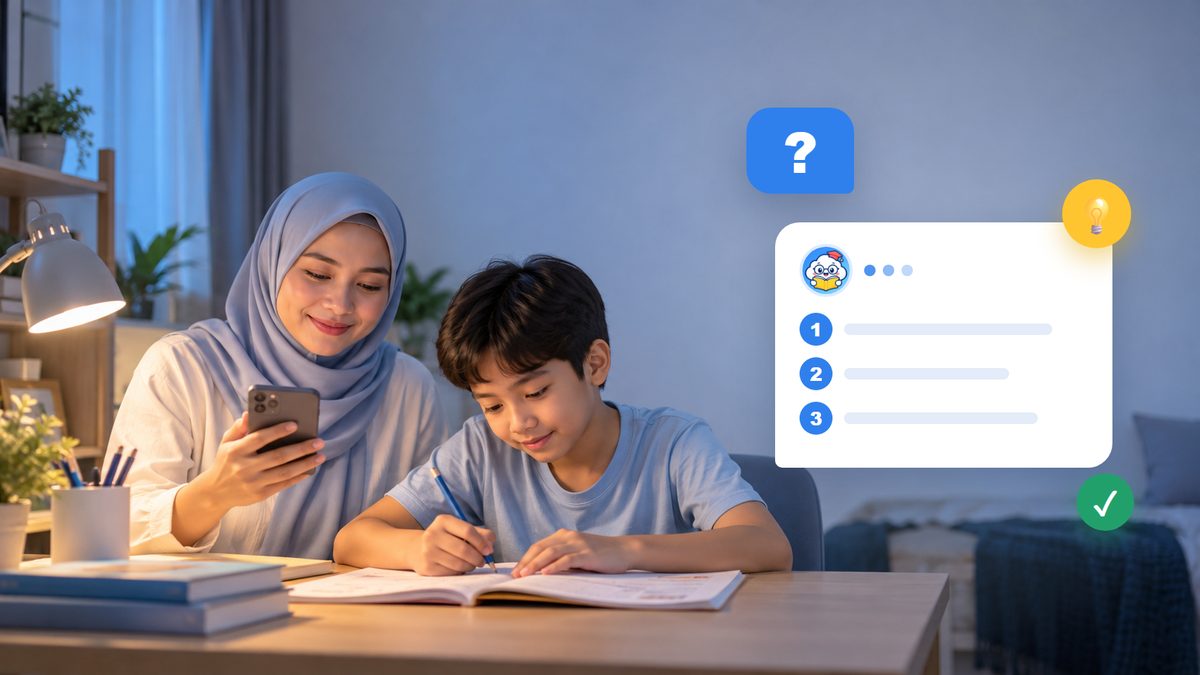
Many parents, especially those with children in SJK(C) or SJK(T), know this moment well: your child brings home a Bahasa Melayu worksheet and you can barely follow it yourself. The good news is that you don't have to be fluent to help. Your most useful role isn't "teacher" but companion, timekeeper and cheerleader. Here are six things you can start tonight, whatever your own level of Malay.
1. Let go of "I can't help because I don't know it"
What children usually need is not a grammar lesson, but someone who sits with them, keeps a regular practice time and says "well done" at the end. It's fine to be honest: "Your Malay is better than mine, so let's learn together." Children often open up more when they hear this, and they pick up a good attitude too: when you don't know something, you work it out together.
2. Read aloud for 10 minutes a day
A language becomes familiar through hearing and speaking it. Each day, ask your child to read a short passage from their BM textbook or workbook to you, two or three times, a little more smoothly each time. You don't need to understand every word. Just notice whether they rush or skip words. Afterwards, ask "What was that about?" and let them explain in your home language. You'll quickly see whether they really understood or were just sounding the words out.
3. Turn the Malay around you into lessons
Malay is everywhere in Malaysia: road signs, shop signs, menus, drink packets, price tags at the supermarket. Make it a game when you're out: "What does that sign say?" One or two new words a day is plenty, such as keluar (exit), tolak (push) and tarik (pull). Words linked to real things stick far better than words memorised from a list.
4. Let your child be the teacher
Ask your child to teach you one Malay word or phrase every day, and really try to use it. To teach something, they first have to be clear about its meaning and pronunciation. If you get it wrong, let them correct you. They'll feel proud, and you'll pick up a few phrases along the way.
5. Learn to look things up together
When you meet a word neither of you knows, look it up rather than guess. A printed Malay dictionary works, or the online dictionary PRPM from Dewan Bahasa dan Pustaka (DBP). Translation apps are useful for single words, but whole paragraphs often come out wrong, so don't rely on them for full answers. If your child is stuck on a question you can't explain, Teacher Sky can walk them through it step by step in English or Chinese.
6. Build sentence patterns before essays
Many children dread BM compositions because they think in another language and translate word by word. It works better to get comfortable with common patterns first, such as Saya suka … kerana … (I like … because …) and Pada hari Sabtu, saya … (On Saturday, I …). Keep a small notebook of good sentences from the textbook and exercises, and flip through it before writing, borrowing one or two. Clear short sentences come first; longer ones follow.
Finally: encourage, and never laugh at pronunciation
Mispronouncing words and picking the wrong one are a normal part of learning a language. If every attempt is met with a correction or a laugh, your child will stop trying. Praise them for speaking up and for doing better than last time, then gently point out just one thing. It also helps to ask the teacher which areas are weaker and how you can support them at home.
Want your child to practise a little every day over the holidays? See How to plan the school holidays. Our KSSR Bahasa Melayu workbooks follow the textbook units and come with full answers, so you can check work even if your Malay is shaky. Every book has a free preview.