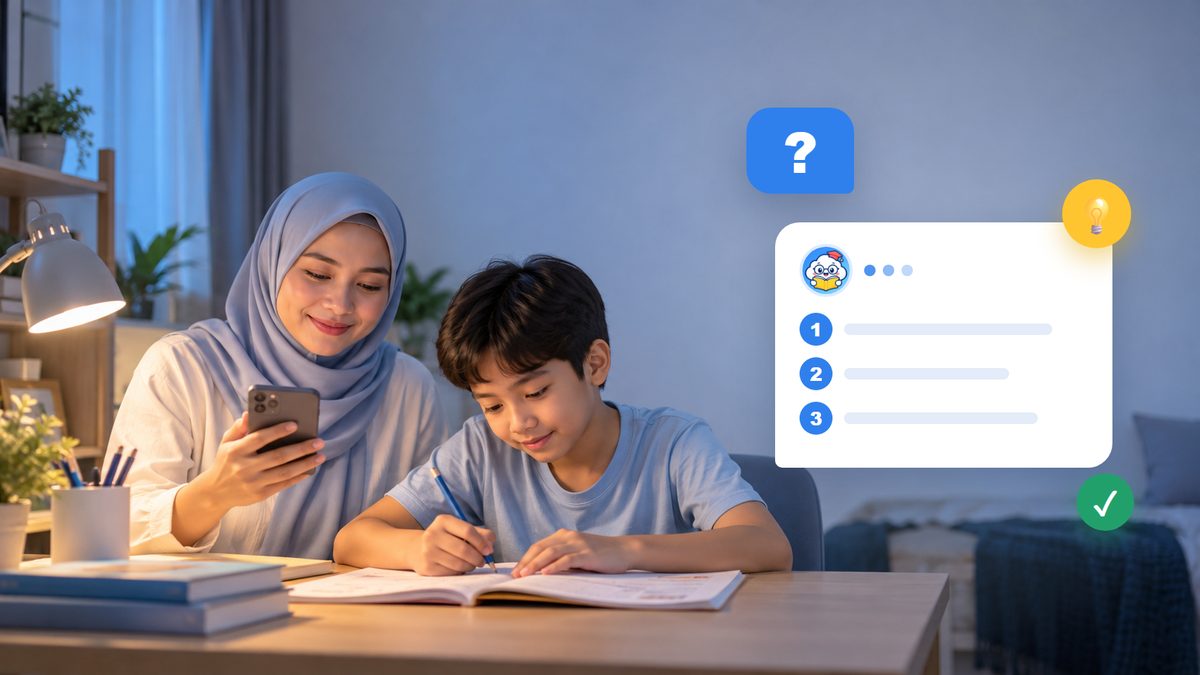
Many children now reach for a phone and ask AI the moment they get stuck. AI is convenient: it answers at midnight and never loses patience. Used the wrong way, though, a child may only learn to copy answers. So is AI answering children's questions a help or a shortcut? It depends on how it's used.
Where AI helps
- It's always there: when parents are tired after work or homework happens late, AI still answers.
- It's patient and can explain another way: if the first explanation doesn't land, ask for another example or a simpler version.
- It reminds parents how school teaches it: many parents can solve the question but have forgotten today's method, such as borrowing in subtraction or Malay imbuhan. AI can remind you of the school's method and terms.
- Language is no barrier: a parent can ask in the language they're comfortable with about Malay, English or Chinese homework.
Where to be careful
- It gives the answer straight away: most AI writes out the answer when asked. The child copies it, the homework gets done, and the test still goes badly.
- AI makes mistakes: it sounds confident but isn't always right, especially with calculations and pictures in questions.
- It chats about anything: a general AI chatbot will happily drift from homework to games and other unsuitable topics, and the evening is gone.
- Privacy: children may type in their name, school or photos. That information shouldn't go into public AI tools.
6 ways to make AI help your child really learn
1. Try alone for 5 minutes first
Ask your child to work on it alone for 5 minutes before asking. Having tried first, they know exactly where they're stuck.
2. Ask "how", not "what's the answer"
Teach your child to ask: "Please don't give me the answer, give me hints step by step." Or ask it yourself: "My child is stuck on this question. How should I guide them?" When AI teaches the method, your child learns it.
3. Sit beside them
For younger children, it's best if the parent asks the AI and then explains in their own words. AI reminds you of the method; you bring the encouragement.
4. Check against the textbook and answers
AI's explanation should match the textbook and the teacher's method. Workbooks with full answer keys let you check straight away whether the AI is right.
5. Let your child explain it back
Afterwards, ask your child to explain the method in their own words. If they can, they've understood; if not, try one more question of the same type.
6. Choose a homework-only tool and keep personal details out
AI for children should answer learning questions only, with no chit-chat and no games. And remind your child never to type their name, school, photos or phone number into AI.
How we designed Teacher Sky
Sky Edu Land's AI, Teacher Sky, was built on exactly these principles:
- It sees the page: ask inside the workbook and it sees the question your child is working on, with no photos or typing out the question.
- It checks against the answer key: on pages that come with answers, its explanation matches the answer instead of guessing.
- It shows parents how to guide: using KSSR methods and terms, step by step, it tells you what to ask so your child works it out.
- Primary schoolwork only: chit-chat, games and unrelated questions are politely declined, so it's safe for children too.
Sign up free and get one complete workbook, plus 15 Teacher Sky questions every month. See the Teacher Sky plans, or preview workbooks free in the shop.
In short
AI isn't here to replace teachers or parents; it's a helper that's always at hand. Try first, ask for the method, check the answer, explain it back, and AI stops being a way to copy answers and becomes a patient extra teacher.